
Starting From Here: Sierra Leonean Culture & Interior Design
Starting From Here
A couple of months ago, I wrote about my experiences in Lagos and how they affected me from an interior designer’s perspective. This is something I wanted to explore further and reflect on how we, as people of the Black and brown diasporas (or any diaspora really) could weave our cultural identities into our home. Bridging the gap between where we come from and where we live to create homes representative of us.
It does pose an interesting question. What does it actually mean for a home to represent where we come from? Is a cultural identity within a home about the objects, the craftsmanship? Is it more about colour, architecture and interior architecture or something less tangible? Something that you can’t quite pinpoint?
Starting this series also coincides with Black History Month in the UK and I feel this is a great Black History project and an opportunity for me to learn. For this series, I have started with Sierra Leone. Why Sierra Leone? Because I’m Nigerian and wanted a culture I know somewhat well but would love to learn more about. I’m using this as an experience to truly learn about a culture and apply those findings into the interior and interior architecture of the space through joinery, bespoke textiles and furnishings.
In this first exploration, I’m looking at Sierra Leonean culture, architecture, textiles and craft, and considering how those influences can inform contemporary interior design.
Sierra Leonean Culture, History & Design

Salone
Sierra Leone (Salone) is a small country in West Africa, with a population just under 9 million. Its capital, Freetown, was founded by liberated formally enslaved Africans after the fall of the transatlantic slave trade in the late seventeenth century. This involved freed Black people from the United States, Canada and the Caribbean who settled amongst the tribes like the Temne, Bulom, Limba and Mende who were already residing in what is now modern-day Sierra Leone. In writing this I don’t want to imply that the history of Sierra Leone starts with the formerly enslaved returning to its coast. Sierra Leone had a lovely rich history and culture before that as well as after. But this time period really helped to shape modern-day Sierra Leone and shape the architectural and design language which is of interest to me.

Sierra Leonean Architecture & Krio Board Houses
Prior to the founding of Freetown in 1792, Sierra Leone’s architecture was largely made up of the indigenous village. This being family compounds (which were common and still are common amongst West Africa), coupled with more seasonal coastal structures.
Different tribes had different building traditions. However, the common features included round or rectangular houses made from timber, mud, clay, woven matting and thatch, with settlements arranged around communal, agricultural, fishing and ceremonial activities.
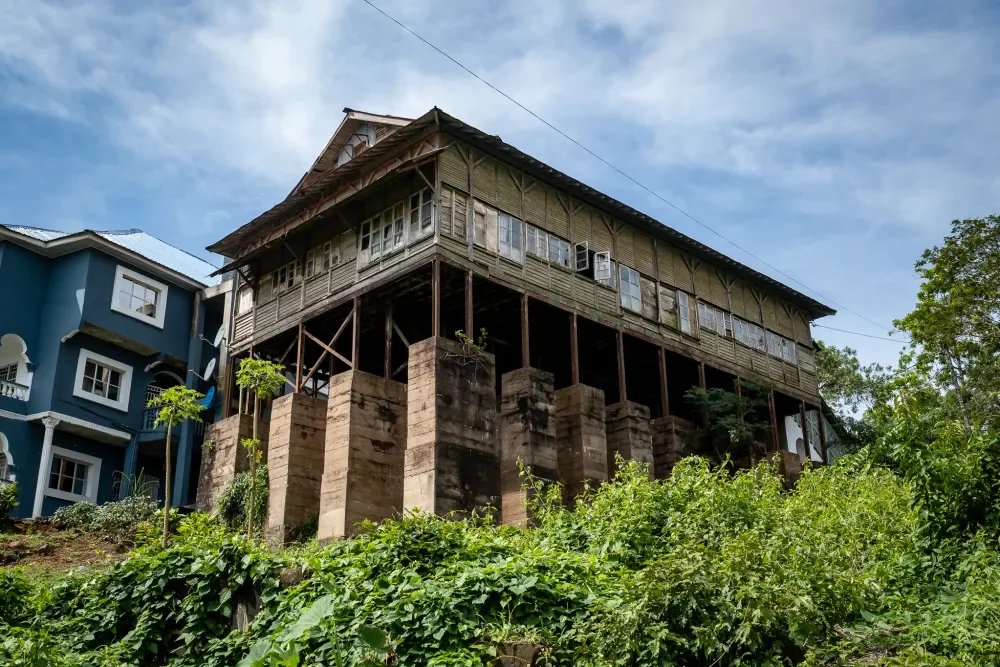
The Krio, descendants of those settlers plus thousands more Africans freed from slave ships, built houses unlike anywhere else in West Africa. They used forest timber to construct board houses often referred to as ‘old bode os’ in Krio. They took architectural inspiration from the colonial homes they encountered whilst enslaved. These homes were often raised on stilts to protect against flooding in the rainy season with lovely large pitched roofs and beautiful wooden carvings.
Sierra Leonean Textiles: Country Cloth & Gara
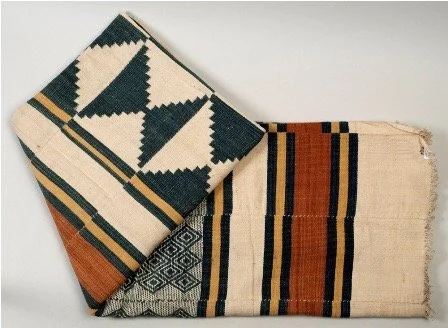
Sierra Leone much like the rest of Africa has a rich textile history. The Mende and Temne have woven country cloth for generations. Traditionally they are made from local cotton and dyed with kola nuts. Narrow strips are sewn into diamonds and chevrons. Alongside it, gara: indigo tie-dye (not always indigo but always tie-dye), centred primarily in Makeni.
The carving
Carving has played a large traditional role in Sierra Leone. There is an artisanal and deep spiritual history.
Soapstone nomoli figures were carved and buried across the south, later turned up by farmers and treated as spirits watching over the harvest. Alongside the black-lacquered Sowei helmet masks, hand-carved from wood for the Mende people’s female-led Sande society. These are masks that celebrate womanhood, beauty and wisdom.
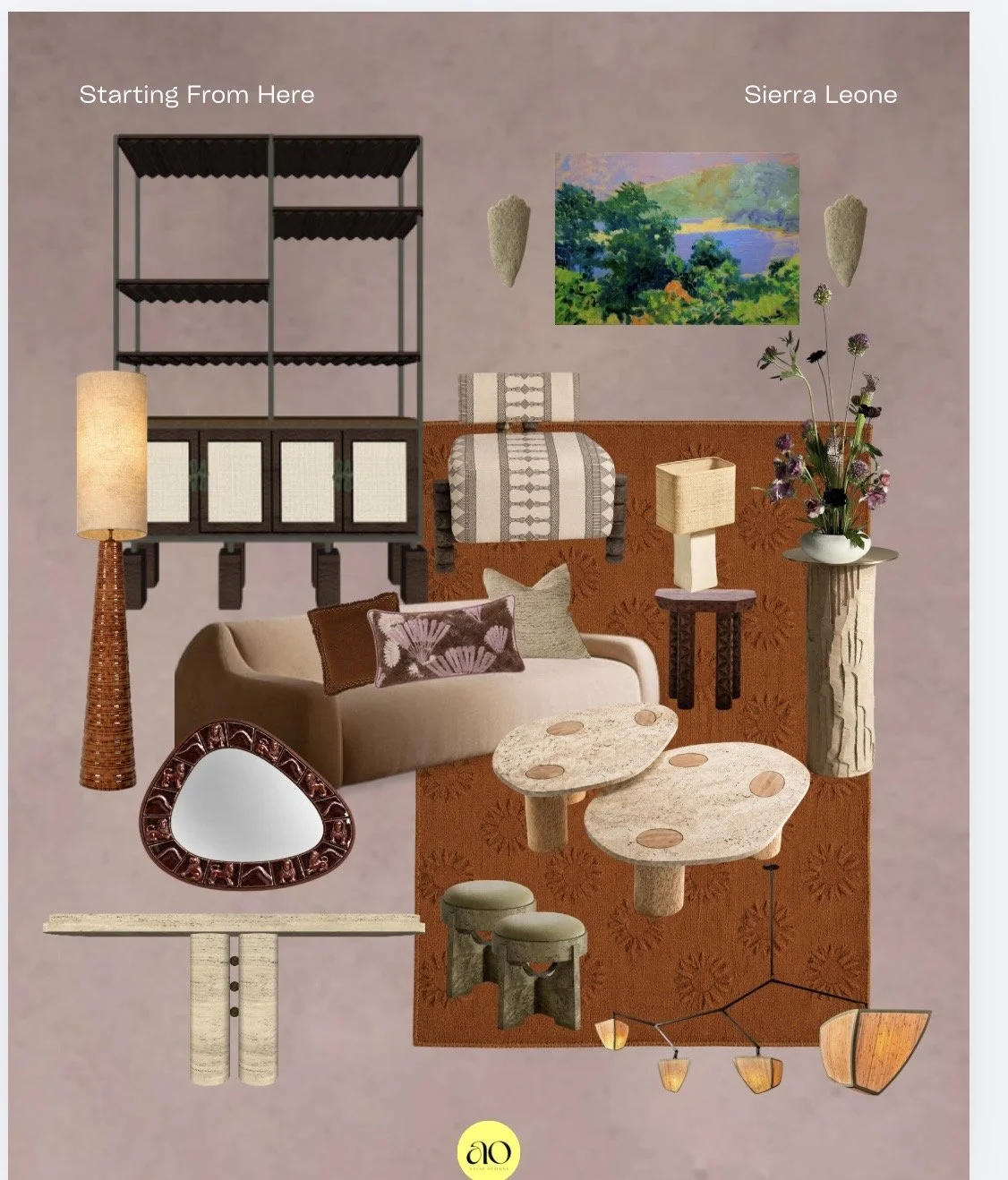
I have now (hopefully) painted a picture of the rich cultural, architectural, and historical snapshot of Sierra Leone. With this as my base I then allowed this to shape my design approach and create a space that feels very contemporary but honours a Sierra Leonean history and influence, creating a very considered space.
It’s an approach I’ve explored elsewhere too, looking at how place, material and cultural identity shape interiors, most recently through my reflections on Sri Lanka.
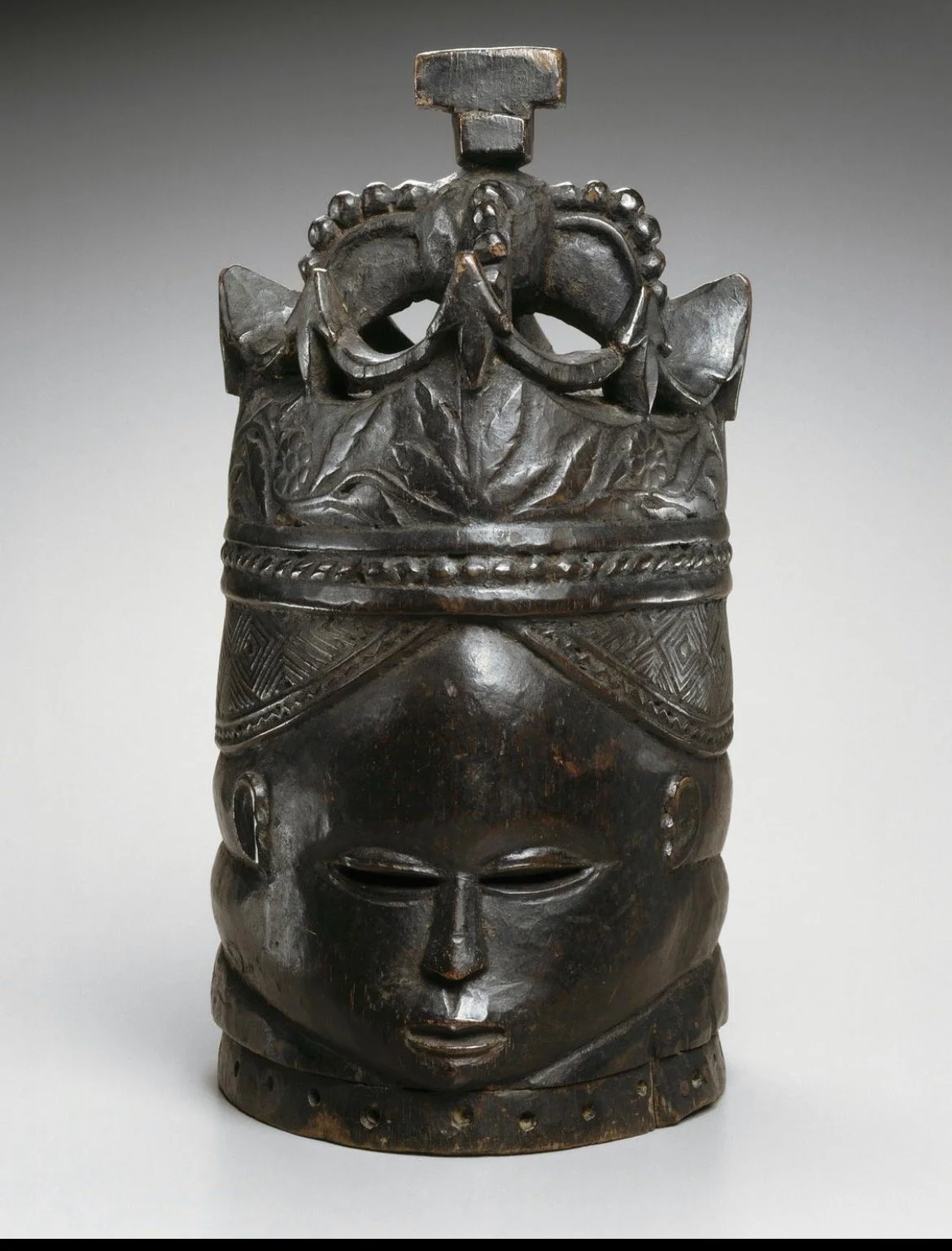
Robert B. Woodward Memorial Fund and Gift of Arturo and Paul Peralta-Ramos, by exchange
My design approach
The joinery
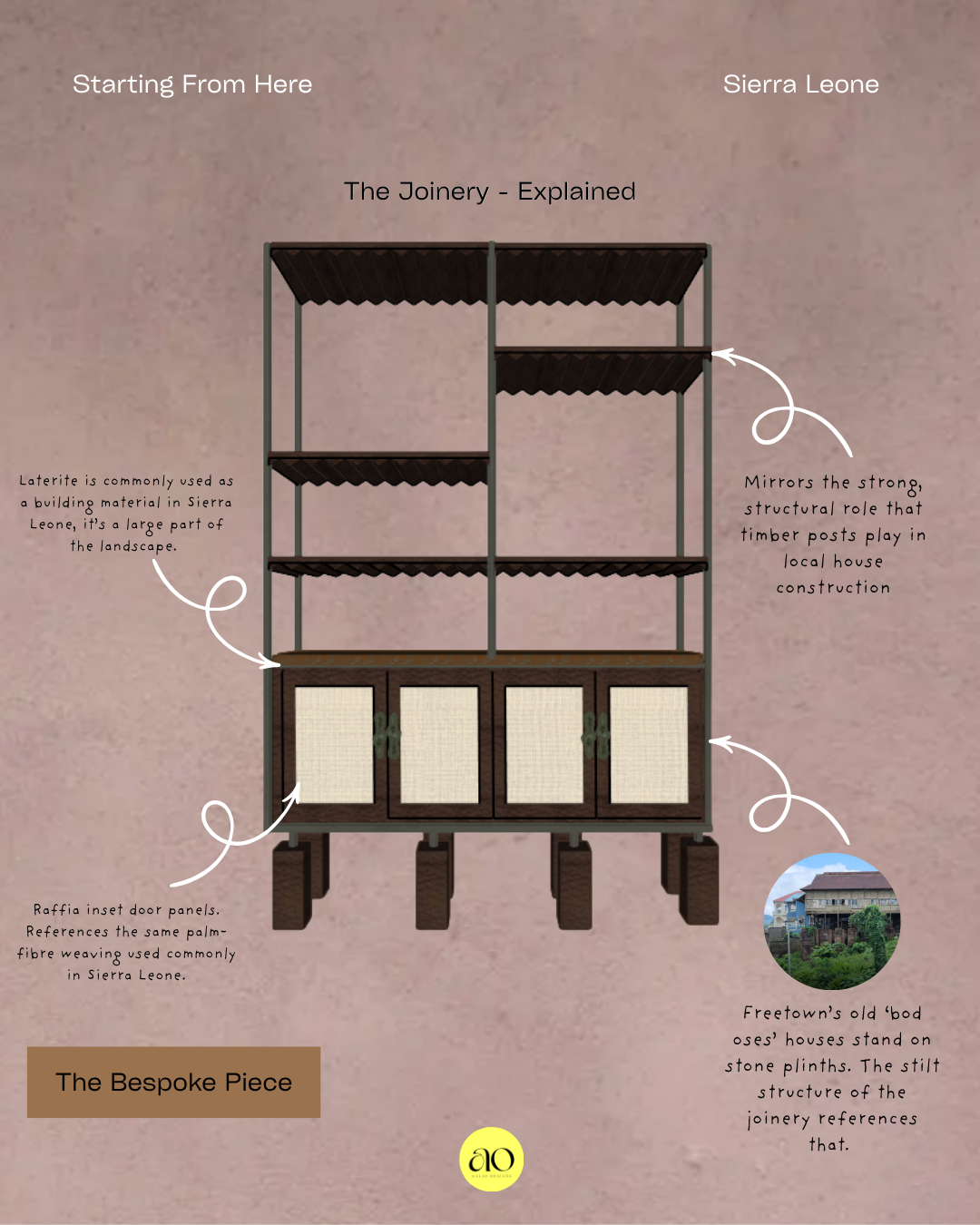
The bespoke joinery has many nods to Salone’s history. The zigzag detailing along the edges of the shelf takes inspiration from country cloth chevron, which is also used for the upholstery on the armchair, subtly linking the woodwork with the textile. The stone top to the piece is an imagining of honed laterite with a clear penetrating sealant applied. Laterite is found extensively in Sierra Leone and is a common building material.
The joinery doors are inlaid with a raffia wallpaper. A nod to the palm-frond weaving history of Sierra Leone and adding textural interest.
The form and structure take direct reference from the old bode os. With the stilt like structure. The bespoke green patinated copper joinery pulls reference from the lush landscape and vegetation of Sierra Leone.
Colour & Materials in Sierra Leonean-Inspired Interiors
This might be the second or third journal entry of mine you are reading. Or perhaps the first! If you know me you know I love colour. I respect colour and recognise the role and place it has. The walls are a dusty pink painted limewash. Vibrance is slightly sun-faded adding a lovely tactile quality to the space.
A vintage gara cloth motif of a sunburst was the inspiration for a bespoke rug designed for this room. Injecting some more colour with the rust shade.
One of the cushions is by Dar Leone, a textile brand founded by Sierra-Leonean- American Isatu Finna. A homeware and lifestyle brand that draws inspiration from the history and landscape of Sierra Leone’s coast and is based in Islington.
The artwork is by Ghanaian-Sierra Leonean architect and painter Arthur Timothy. Arthur was raised in Sierra Leone until he was nine and much of his artwork draws from this.
The artwork in the room, The Songs of the Forest, is oil on canvas and was exhibited in his solo show Othello’s Countrymen (The Krio Enigma) at Gallery 1957 in London, drawing on memory, family photographs and Krio identity.
The lampshade is a bespoke conceptual idea. A plain linen shade on the outside, lined with wallpaper from Dar Leone depicting Banana Island, a lovely subtle detail. With the idea of you being able to see the pattern when lit.
Contemporary Voices
I owe a lot of the research in this essay to contemporary voices in Sierra Leone and the diaspora. I’ve listed my sources below but in particular I have found Google Arts and Culture to be very helpful as well as the Sierra Leonean Heritage Museum and Sierra Leonean Heritage.org.
I also want to thank my Salone family Bila, Atu and Laura who I met in school and have shared snippets of Sierra Leone and their lovely culture with me. That in turn inspired me to write this piece.
References
Art-View-Snapshots: Sierra Leone
About Sierra Leone: History | UNIPSIL
Sierra Leone's Colourful Heritage
West African Art: Liberia and Sierra Leone | Art History Teaching Resources
Board Houses: Sierra Leone's Unique Architecture
Board Houses: Sierra Leone's Unique Architecture
https://academic.oup.com/edited-volume/61663/chapter/553447441
Sierra Leone - Wildlife, Mangroves, Rainforest | Britannica
Siddle, D. J. (1968) Patterns of rural settlement in Sierra Leone: methods of geographical analysis in a tropical environment. Doctoral thesis, Durham University.
University of Pennsylvania Museum of Archaeology and Anthropology. “Daily Life in Sierra Leone: Architecture.” Available at: https://www.africa.upenn.edu/sherbro/architecture.html
University of Pennsylvania Museum of Archaeology and Anthropology. “A Fisherman’s Shimbek on Plantain Island.” Available at: https://www.penn.museum/sites/SierraLeone/fishingstructure.html
Encyclopedia of World Cultures. “Temne.” Encyclopedia.com. Available at: https://www.encyclopedia.com/humanities/encyclopedias-almanacs-transcripts-and-maps/temne
Finn, J. “Sierra Leone Settlement Forms and Internal Structures.” Durham E-Theses. Available at: http://etheses.dur.ac.uk/9643/1/9643_6432-vol1.PDF
Encyclopaedia Britannica. “Sierra Leone: Plant and Animal Life.” Available at: https://www.britannica.com/place/Sierra-Leone/Plant-and-animal-life
University of Makeni. “A Brief Time Line of the Early History of Sierra Leone.” Available at: https://unimak.edu.sl/wp-content/uploads/2021/06/A-pre-history-of-Sierra-Leone-final-copy.doc
